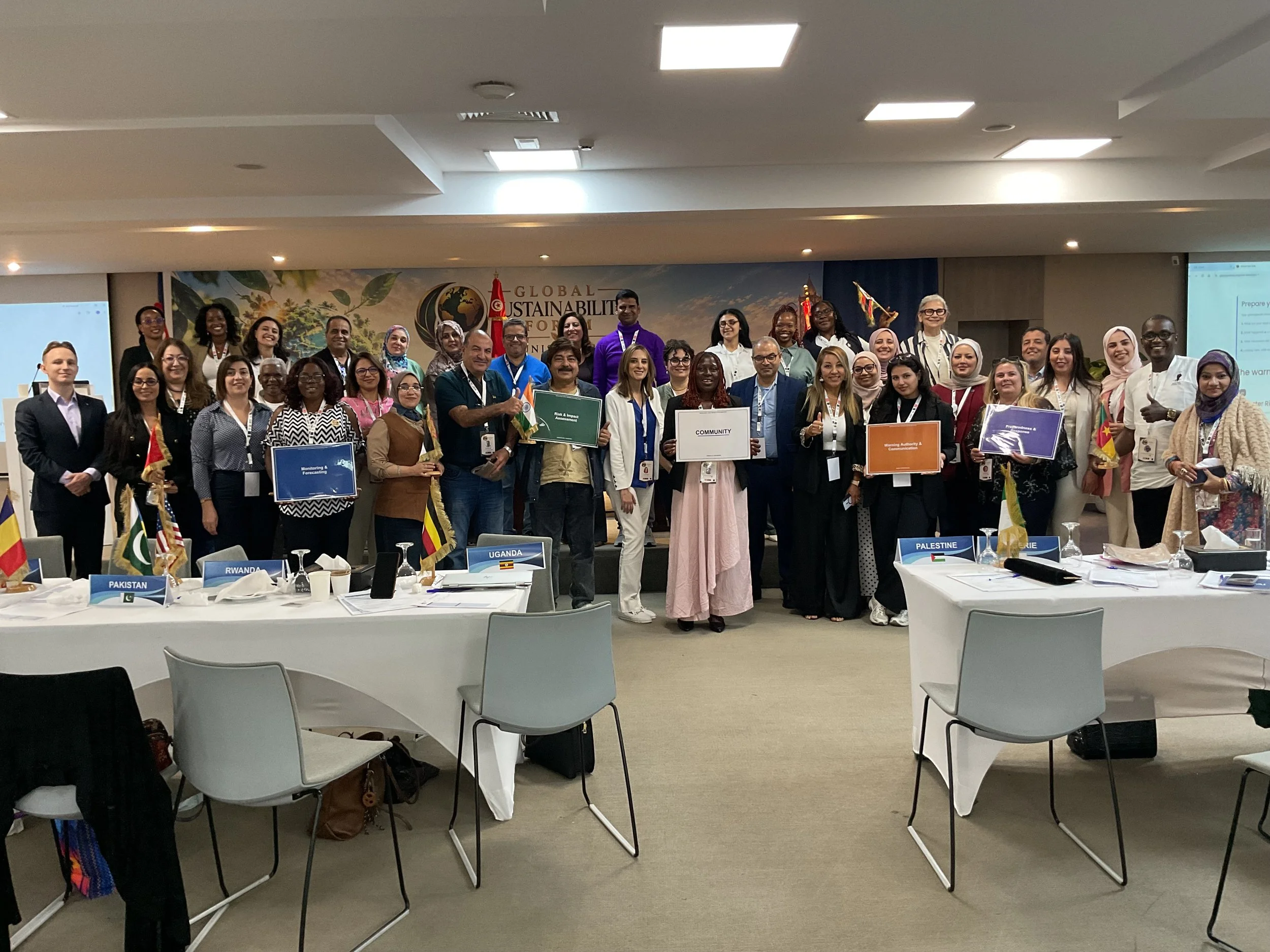
Global Safe Hub Delivers Early Warning Systems Simulation Training at the Global Sustainability Forum in Tunis
On 25 October 2026, as part of the Global Sustainability Forum in Tunis, Tunisia, Lubna Qaryouti , the managing director of Global Safe Hub delivered an interactive Early Warning Systems (EWS) Simulation Training, bringing together participants from different countries across Asia, Africa, and the Middle East.
Using an original web-based simulation developed by Global Safe Hub, participants engaged in a fictional flash-flood scenario, working across five interconnected teams representing the essential functions of an effective early warning system.
Aligned with the four pillars of Early Warnings for All (EW4All), the exercise challenged participants to interpret evolving hazard information, coordinate decisions, communicate warnings, and translate early warning information into timely action.
Key Takeaways
1. Early warning systems are a chain. Their effectiveness depends on coordination, timely information-sharing, and strong connections between all actors.
2. Technology alone is not enough. Even the most advanced forecasting systems and equipment cannot protect lives if warnings fail to reach local communities early enough, clearly enough, and in a way that enables action.
3. Communities must be at the centre. Community feedback is essential to identifying barriers, improving communication, and ensuring warnings lead to protective action.
Strengthening People-Centred Early Warning Systems
The training provided an opportunity for participants from different regional and professional backgrounds to exchange perspectives and experience the challenges of early warning coordination in a dynamic, simulated emergency.
Through this practical learning approach, Global Safe Hub continues to promote disaster risk reduction, preparedness, and people-centred early warning systems.
This simulation is an independent educational exercise developed by Global Safe Hub and aligned with EW4All principles.